
This review delves into the CoreLogic Rental Pulse report for May 2023, which highlights Australia’s record rental increase. According to the report, the combined capital cities have seen an annual rental increase of 11.7%, largely due to a significant shortfall in rental listings and an increase in overseas migrants and international students. We will examine the report’s key findings, including the driving force behind the surge in rental prices, the affordability of rental properties, and the future outlook for renters in Australia.
Download a copy of the CoreLogic Rental Pulse Report – CLICK HERE
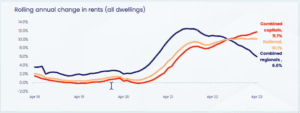
In April 2023, the national dwelling rental index recorded an increase of 0.8%, up 2.8% over the past three months and 10.1% higher for the year. The report shows that the surge in rental prices is underpinned by increasing demand for capital city units, which continue to outpace house rents. Unit rents increased 1.6% in April, while house rents increased 0.9%.
The driving force behind the surge in rental prices is the mismatch between supply and demand. Over the four weeks to April 30th, the total supply of capital city rental listings was -20.9% below the level recorded this time last year and -39.8% below the five-year average. Except for Hobart and Canberra, vacancy rates across the capitals remain near record lows, making it difficult for renters to find suitable accommodation.
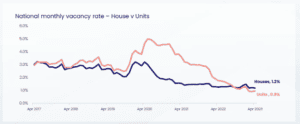
The report also shows momentum is easing across regional rental markets as internal migration rates normalise and vacancy rates move off recent record lows. Regional rents rose 1.3% over the past three months and 6.0% over the year to April, down from a cyclical peak of 12.5% over the 12 months to November 2021.
The report shows that growth across capital city unit rents continues to outpace house rents, reflecting both the strong demand from migrants and foreign students, who typically first settle in medium to high-density housing, as well as a preference for more affordable accommodation. Regarding affordability, Adelaide has overtaken Melbourne as the country’s most affordable rental capital. At the same time, Sydney remains the most expensive capital to rent in after displacing Canberra three months ago.
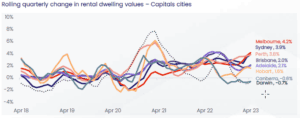
Sydney and Melbourne continue to record the most robust growth in unit rents across the capitals. In April, both cities recorded a new peak growth rate in quarterly and annual trends. Sydney’s unit rents increased 5.8% for the rolling quarter and 19.1% for the year to April, while Melbourne’s unit rents rose 5.0% for the three months and 15.2% over the year.
Despite signs of easing in regional rental markets, it is unlikely that there will be much relief for renters in the short to medium term. The flow of migrants into Australia is expected to remain high, and rental supply is expected to stay low. Given that the flow of new unit approvals has held below average since 2018, the rental market will likely continue to have supply issues over the medium to long term.
In conclusion, the CoreLogic Rental Pulse report for May 2023 highlights the record rental increase in Australia, primarily due to the mismatch between supply and demand. The report shows that growth across capital city unit rents continues to outpace house rents, reflecting strong demand from migrants and foreign students, and a preference for more affordable accommodation. With vacancy rates remaining near record lows and rental supply expected to remain low, it is unlikely that there will be much relief for renters in the short to medium term.